Wednesday, December 16, 2015

SMUHSD Focusing on Equality & Acceptance

A cultural shift is in the San Mateo Union High School District is underway, as students are leading an effort to make their schools more inclusive and accepting of all lifestyles.
Schools throughout the district are overhauling long-standing customs such as how students are recognized at the annual homecoming event, the design of the former powder-puff football game, the allowed graduation garb and signs on bathroom doors which welcome transgender students, among other efforts.
These changes to some of the pillars of the high school experience represent a larger effort by students, teachers, staff and administrators to move away from cultural norms of previous generations, in an attempt to create a more welcoming environment for all students, said Superintendent Kevin Skelly
Ghajarrahimi said she and her fellow classmates feel empowered by the ability to change traditions they do not feel are representatives of their generation’s beliefs.
“It makes me feel very good to see the growth of my school,” she said. “We can see the changes that have happened and the student body feels like their voices are being heard more.”
(Ghajarrahimi is a student at Aragon High School.)

To read the entire article :http://www.smdailyjournal.com/articles/lnews/2015-11-02/high-school-students-drive-cultural-revolution-inclusion-acceptance-equity-become-focus-of-new-campus-lifestyle/1776425152863.html

Do you think this is an accurate representation of all the high schools in the San Mateo High School? Do you think that the changes that are being made are inclusive and fair to all student? Do you feel that your voice and student body is equally heard as Aragon High School? Are there different solutions to these issues, if so what do you suggest? Are there other issues the district should focus on to create a more inclusive environment at high schools?

US House Speaker Paul Ryan says budget deal has been reached

http://www.bbc.com/news/world-us-canada-35114088

United States Speaker of the House Paul Ryan recently announced that Congress and the White House have reached an agreement on a new spending bill of approximately 1.1 trillion USD that addresses both Republican and Democrat policy and initiatives. This new spending bill will carry the US government through the 2016 budget year, and if it passes, will prevent yet another government shutdown. As written, the bill sees a proposed increase in defense spending and extension of tax credits, and to the dismay of more conservative members of congress does not deny federal funding to Planned Parenthood, nor does it allocate funds to tighter screening of Syrian refugees entering the country. What's more, the bill includes proposed changes to visa requirements for those traveling to the US, allows for more special interest tax breaks, a lift on a 40 year old crude oil export ban, and delays and suspension on taxes meant to fund Obama's Affordable Cart Act. The budget package, which includes both the spending bill and a new tax bill, will be voted on by the end of the week. Speaker of the House Paul Ryan described the process of reaching a consensus on the spending bill a "crap sandwich".

How will the new spending bill affect both foreign and domestic policy? Was there a clear winner (Republican vs Democrat) in terms of the spending bill? Is the bill's increased funding to defense spending justified/warranted? What does the process leading up to the creation of the new spending bill say about contemporary US politics, especially in context of political parties? Are you satisfied with the new spending bill, and if not what would you amend?

Linda Qiu - PolitiFact

On Tuesday night in Las Vegas the Republican presidential candidates once again took the stage for their final debate of 2015. The first debate since the terrorist attacks in Paris and San Bernardino, national security and strategies to defeat ISIS were anticipated to be and were contentious topics of debate. In personal jabs at recent statements or voting records, each candidate asserted the merits or their position on each issue while attacking other candidates' proposed solutions.

However, many facts, statistics, or other things cited by candidates during the debate simply weren't true. The website PolitiFact is dedicated to analyzing politicians' statements and assessing their factuality, picking out some key points from the debate and with this being the final debate before the primary season officially begins, most of what candidates have said will be what sticks with their base and will be quoted as "fact" into the election season.

What impact does truthfulness (or lack there of) of candidates public assertions have on the public during the election season?
Should candidates be reprimanded for incorrect statements?
Where is the line between bending the truth for a political purpose and actual slander?
If restrictions were enacted, could candidates simply misspeaking put them at risk?

Monday, November 23, 2015

How terrorism in France could shape an election in America

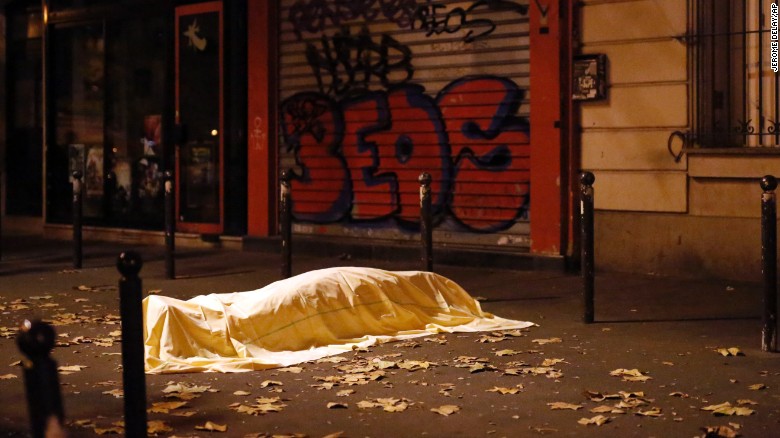
Night of Terror: Paris Attacks
A body, covered by a sheet, is seen on the sidewalk outside the Bataclan theater

http://www.cnn.com/2015/11/14/politics/paris-attacks-2016-presidential-candidates/

Due to the recent events that have been happening around the world by a group called ISIS, many candidates that are currently running for presidency have changed their stance and ideologies upon tackling the now current world issue. While they have already responded and commented about the incidents, each candidate didn't seem to have any understanding of what to do or any strategy whatsoever. It was noted that "they seemed to encapsulate the impotence of politicians who so far have only words to combat a burgeoning terror threat." Although they could not answer the questions to help boost their own stance in the runnings they were able to "offer a confident contrast with an administration that now appears to lack success in the fight against terrorism." The GOP candidates have now turned the table by using these events to attack the Democratic party and those who run under the Obama administration, namely Hillary Clinton. It goes without saying that it was a harsh political irony that the killings in France took place on the same day that an interview aired in which the President argued that his strategy had "contained" ISIS in Iraq and Syria, although it was still a better response than Trump who for instance, said this week that he would "bomb the s--- out of ISIS." The GOP have already turned this crisis into an opportunity to grant them leverage by arguing that they should increase restrictions on immigration policies and gun control. To quote Trump, "When you look at Paris -- you know the toughest gun laws in the world, Paris -- nobody had guns but the bad guys. You can say what you want, but if they had guns, if our people had guns, if they were allowed to carry ... it would've been a much, much different situation." The former Arkansas Gov. Mike Huckabee has already weighed in on the situation by saying that "if a left-wing, politically correct country like France will close its borders, it's time for us to put a moratorium on people coming here from countries where there are people with al Qaeda or ISIS ties," calling for a stricter set of regulations for immigration. But the Paris attacks also expose Republicans to political vulnerabilities over ISIS. While the GOP loves the kind of hawkish rhetoric that Rubio and others doled out at a presidential debate in Milwaukee, America remains weary of foreign wars, leaving little political room for the new commitments proposed by Republicans. And the legacy of President George W. Bush, whom many Democrats blame for ripping the lid off boiling sectarian strife in the Middle East with the invasion of Iraq, continues to haunt the GOP when it comes to national security policy.

How will these events affect the campaigns by both parties? What is your opinion on each party's stance and response to these situations(might want to read full article)? What do you think we should do in terms of foreign policy? What is your opinion on the matter?

Sunday, November 22, 2015

What do we define as Islamophobia?

https://www.youtube.com/watch?v=yWNv97yq4Fc

            In light of recent events, there has been an increased dialogue into the conversation of Islamophobia or prejudice against Muslims. Bill Maher has been on the receiving end of a lot claims that he is prejudiced, and is unjustly putting down Islam. Maher's argument is that we as a society must question religion itself and not be scared out of having conversations questioning religions because some may deem those conversations as prejudiced. He claims Islam, or Shariah law (the laws that govern Islamic theocracies) promotes anti-progressive ideas. He cites anti-feminist laws such as forced female circumcisions, how woman can get married at any age and as a byproduct raped at any age, and how some women can't leave there houses without male supervision as instances of institutional sexism in these countries. He also points to laws that allow Gays who have come out to be killed as instances of homophobia or hate that as byproduct of not questioning Islam we are in some way allowing. He does concede that some people receive a grace from Islam and can coexist within the religion whilst disagreeing with these hateful acts. He says however that these people are are not the majority, he also doesn't claim radical islamic groups are the majority either, he says the majority is somewhere in between the two. The majority, to Maher, is one that accepts Shariah law and allows the unprogressive hateful acts to be continued. He does not blame the people but rather the dogma of this specific religion. What do you think? Is disagreeing with Islam inherently prejudiced? Is Maher being prejudiced? Is disagreeing with theocracies and Shariah Law prejudiced? What is Islamophobia?

Colbert interviewing Maher

On Monday, Stephen Colbert interviewed Bill Maher – a comedian, talk show host of "Real Time" and a staunch liberal. Though the two are generally both considered to tend towards the far left wing, the interview was filled with awkward conversations and confrontations. For example, in response to Stephen saying that though he "sucks" as a Catholic, religion gives him a "connection to our ancestors," Maher replied with, "These were men who did not know what a germ or an atom was, or where the sun went at night, and that's where you're getting your wisdom from. Anyway, but let's not argue." This interaction was especially odd because Maher was portraying Colbert as being much more religious and conservative than most others would consider him to be. In the face of the recent ISIS attacks on Paris, Maher asserted that "if only ISIS believes that anyone who leaves the religion should be killed, well, then maybe we can finally kill all of ISIS. But what if that is 20, 30, 40% of all Muslim people in the world?" Though not his intention, Maher brought up a touchy subject by insisting that a large portion of the Muslim religion is inherently bad.


Maher could be considered a liberal extremist, but liberal ideology places a huge emphasis on freedoms - freedom of religion, freedom of speech, freedom of marriage etc. When someone is liberal to an extreme, do their beliefs come full circle and resemble conservative beliefs (Maher criticized the Islamic religion for being sexist, but in doing so suggested that all Muslims shared this belief)? Is it more important to protects some groups' rights over others? In this time of crisis (ISIS attacks), is subjugating Muslims to some sets of stereotypes for the purpose of protecting the majority of people morally permissible?

Thursday, November 19, 2015

AUMF After Paris Attacks


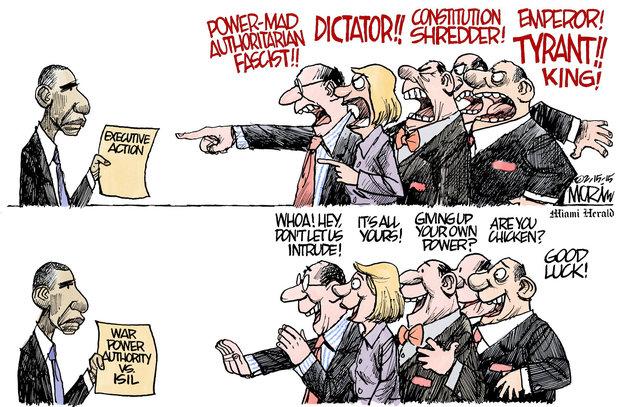
This week, the Obama administration is expected to send in a request for an AUMF against ISIS, in light of recent terrorist attacks in Paris. The AUMF proposed by Obama allows ground troops to be planted in certain scenarios, but it prohibits the use of "enduring offensive ground forces". The previous draft of the AUMF outlined the use of ground troops for specific operations, but many politicians running for the presidency are advocating for a different AUMF. Many contenders for the presidency were questioned this week on their stance on the current AUMF, and conflicting views were offered. Many of the candidates hold the unifying view that the United States will have to involved in some manner in the Middle East to end the terrorism of ISIS. However, the degree of involvement varies by candidate. Lindsey Graham argues that the issue with ISIS cannot be resolved without American troops being deployed in the Middle East, whereas Marco Rubio is in favor of pursuing an international coalition with the support of Iraqi and Kurdish forces. While the plans offered by each candidate were non-specific, none of the candidates have ruled out the use of ground forces in the Middle East.


Do you agree with the political leaders that American military involvement is required? Why do you think all the candidates believe military involvement is the key to ending terrorism? What level of military involvement do you think is appropriate? Do you think their responses were formed too quickly (do we have all the facts)?